

.png)
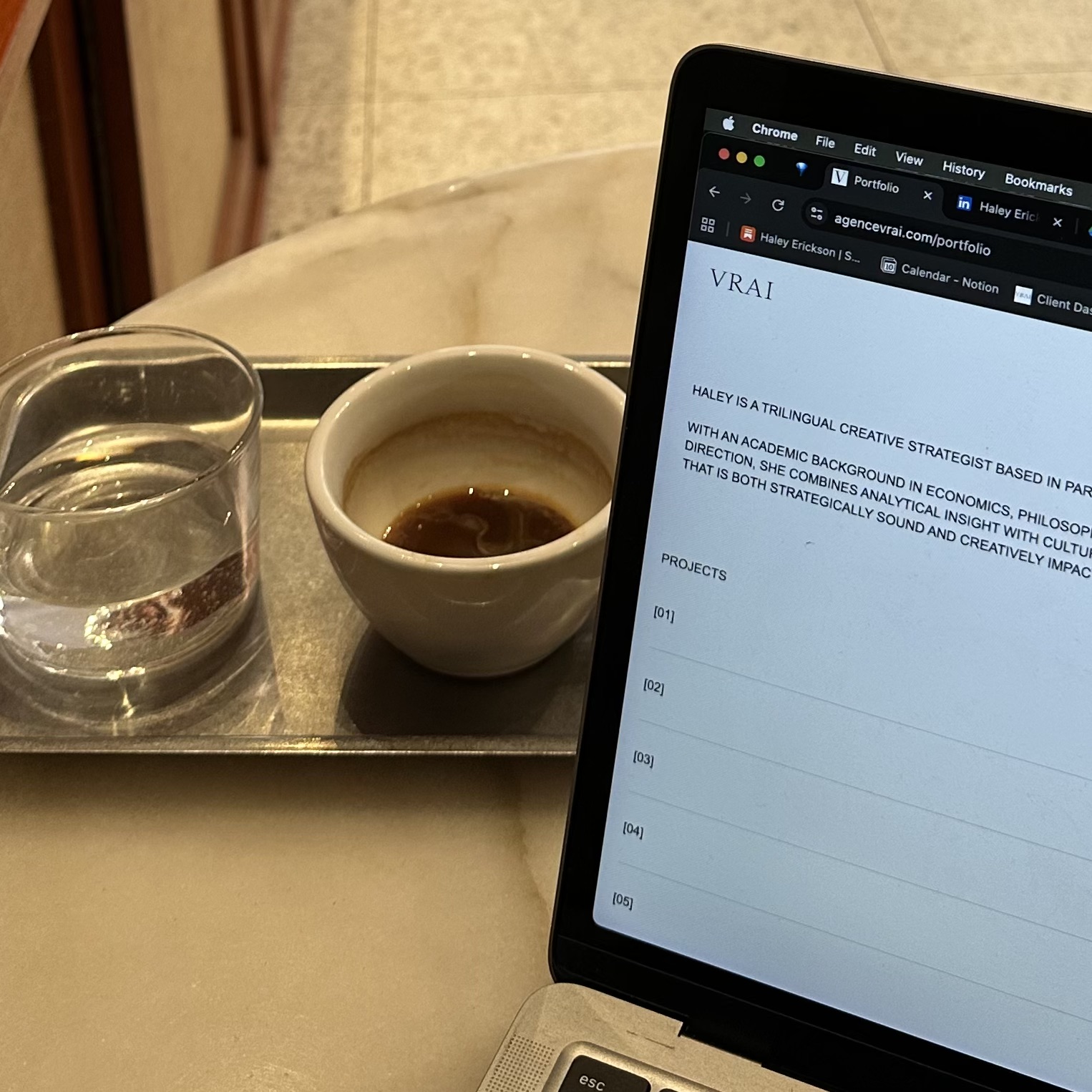
A tiny coffee bar in Paris became an unexpected lens into a broader shift in consumer behavior. Through the insights of hospitality, retail, and luxury fashion, the essay explores a recurring tension of modern life: as experiences become increasingly accessible and optimized for mass appeal, the value of the specific, the intentional, and the distinctive grows. A reflection on consumption, attention, belonging, and why the pendulum always swings back.
November 2025
I am sitting in a coffee bar in Paris on a morning that has become unexpectedly clarifying. I have been thinking about the eventual end of my life here, and perhaps because of that, I have started to notice the city with a kind of renewed attention rooted in gratitude. There is something useful about the anticipation of departure in that it interrupts habituation.
This particular coffee bar has long been one of my favorite places in Paris. It is also one of the smallest. There are two tables, a customised La Marzocco machine positioned against a milk-chocolate-colored marble counter, cream walls, chestnut wood, shelves of brewing equipment, and a tightly edited selection of coffee. The orange packaging of the beans provides almost the only significant interruption to the muted interior. There is little in the space that does not contribute directly to the preparation, consumption, or understanding of coffee. From a branding perspective, this is all intentional.
What interests me is not minimalism for its own sake. It is the degree of conviction required to remain so narrow.
Contemporary retail tends to treat limitation as a problem to be solved. A successful café can add food, merchandise, evening service, more locations, collaborations and adjacent categories. Each addition represents another potential revenue stream and another reason for a customer to enter. The economic logic is obvious. Yet the opposite proposition can also create value. By refusing to become several things at once, this coffee bar communicates an unusual degree of confidence in one thing. Great coffee.
That distinction has become increasingly important because the defining scarcity of contemporary consumer culture is attention. Herbert Simon recognised the basic problem as early as 1971, arguing that an abundance of information necessarily creates a scarcity of the attention required to process it. His observation preceded the internet, social media and algorithmic recommendation systems, but the underlying economics have only become more pronounced. As information and choice proliferate, the ability to decide what deserves sustained attention becomes increasingly valuable.
The coffee bar operates as a small architecture of attention. Because there is comparatively little to choose from, attention moves towards the object being selected. Differences in origin, roast, preparation, acidity or texture are accentuated. This restriction gives choice a more clarifying structure.
There is a behavioral dimension to this as well, although the popular idea that “too much choice is bad” calls for nuance. Sheena Iyengar and Mark Lepper’s now-famous 2000 experiments found that consumers exposed to a smaller assortment were, under certain conditions, more likely to make a purchase and reported greater satisfaction than those confronted with a much larger one. Subsequent research has made the argument more precise rather than simply confirming a universal “paradox of choice”: a large meta-analysis found that choice overload is particularly likely when assortments are complex, preferences are uncertain, the decision is difficult, or the consumer is trying to minimize effort.
The implication is that more becomes valuable only when the consumer possesses a sufficiently developed framework for distinguishing among the options. This is where curation, expertise and point of view acquire economic significance. A narrower assortment can reduce the cognitive burden of selection while simultaneously making the distinctions within that assortment more meaningful.
Sitting there made me reconsider an argument I had been developing about the direction of consumer culture in Paris. My earlier instinct was to describe the city as splitting into two futures: one composed of hyper-specific businesses organized around craft, depth and trust, and another increasingly shaped by scale, virality and mass appeal. I no longer think “two futures” is quite right. The more accurate observation is that two market logics are operating simultaneously, and that each intensifies the appeal of the other, depending on where your values lie.
The first is expansion. Paris is increasingly integrated into the same global consumer networks that have already reshaped cities such as London, New York and Los Angeles. Brands that were once geographically or culturally more distant from the French consumer now move across markets with considerably much less friction. Glossier formally entered the French market through Sephora in June 2025. Reformation opened its first continental European store in the Marais later that year. Alo established its first French stores in Cannes and Saint-Tropez in May 2026, with a major Paris flagship planned for the Champs-Élysées.
The most extreme recent example was perhaps Shein’s arrival inside the BHV Marais in November 2025. Its first permanent physical store opened not on the commercial periphery but inside the historic Parisian department store directly opposite the Hôtel de Ville. The decision provoked protests from employees, politicians and French brands, partly because the ultra-fast-fashion model seemed so discordant with the cultural identity BHV had historically tried to project. Seven months later, following a change in the department store’s ownership, BHV announced that it would end the partnership; its incoming management described the experiment as a mistake. Yeah.
The episode is useful because it complicates any simple narrative of global homogenization. Paris is plainly experimenting with global consumer formats, but it is not doing so passively. Imported models encounter existing institutions, aesthetic conventions, regulation, local expectations and ideas about what the city should represent. The result is not the straightforward Americanization or even globalization of Paris, but an ongoing negotiation between international commercial scale and local cultural legitimacy. See Le Butter Shop.
What has changed more decisively is the infrastructure through which consumers discover the city. Social platforms now operate as informal search engines, guidebooks and systems of cultural recommendation. A restaurant, exhibition, bakery or object can move from relative obscurity to global recognition in a matter of weeks because one highly legible image is reproduced often enough.
A 2025 Le Monde examination of social media and tourism described Instagram and TikTok as increasingly central to how travellers choose destinations, while recent tourism scholarship has gone further, examining how algorithmic recommendation systems repeatedly concentrate visibility around a comparatively narrow group of already legible places. One 2026 study describes this as “digital overtourism”: concentration can begin at the informational stage, before anyone has travelled at all. Related research argues that influencers and algorithms increasingly reshape the symbolic meaning of destinations before physical patterns of tourism have even changed.
This begins to explain a strange paradox of contemporary travel. The quantity of information available about Paris has never been greater, yet the version of Paris most frequently presented to visitors can feel remarkably narrow. Search for what to do, where to eat or what to buy, and an immensely complicated city is often reduced to a recurring sequence of highly communicable experiences: a specific food, a particular café table, an engraved object, an exhibition, a vintage store, a photogenic façade. There is nothing inherently wrong with any of these places, many become popular because they are genuinely good. The more consequential issue is the feedback loop through which visibility reproduces visibility. Once something becomes algorithmically legible, it attracts more visitors; those visitors create more representations of it; the accumulation of representations makes the place still more likely to be recommended.
This is what I mean by a sugar-high market. I do not mean that the products within it are necessarily shallow, nor that popularity is evidence of inferiority. I mean a market in which demand is increasingly characterized by accelerated cycles of stimulation: discovery, rapid visibility, concentrated attention, replication, saturation and replacement. The “high” is the velocity of attention. A business can become culturally ubiquitous before it has had enough time to establish whether the underlying proposition can support that ubiquity.
This is particularly visible in hospitality. Between the global chain and the longstanding neighborhood institution, there is now an expanding category of independently owned places that adopt the distribution logic of digital mass culture. They may be small, locally conceived and aesthetically distinctive, but their interiors, products and identities are also unusually compatible with circulation through a screen. A particular color, pastry, vessel, typeface, material or architectural feature functions almost as an identifying symbol. The experience has been designed within a visual environment where the ability to survive social-media compression has obvious commercial value.
There is no reason to dismiss these businesses simply because they are photogenic. The more interesting question is what remains once the image has succeeded. Some places convert an initial burst of visibility into enduring loyalty because the product, service and underlying point of view justify repeated attention. Others remain dependent on novelty and consequently become vulnerable to the same mechanism that made them successful in that the feed must eventually move on.
The two-table coffee bar sits at the other end of this spectrum, although it is not outside the attention economy. Its appeal also depends on distinction. The difference is that the distinction arises from the intensity of its proposition rather than from the breadth of its communicability. It asks less of the consumer at the level of choice and more at the level of attention and discernment.
This tension between imitation and differentiation is hardly new. Georg Simmel described fashion more than a century ago as a social process animated by both impulses: people imitate in order to belong and differentiate themselves in order to remain distinct. In his account, a fashion loses some of its differentiating capacity as it spreads, prompting the search for another. Karl Lagerfeld famously quotes, “trendy is the last stage before tacky”.
The contemporary consumer market is considerably less hierarchical than Simmel’s original class model, and cultural movements now travel in multiple directions rather than simply from elites downward, however the underlying tension remains useful. Cultural value is often generated through specificity, copied through imitation, expanded through commerce and eventually weakened by the very ubiquity that commercial success produces.
This is the pendulum I have been trying to describe. A niche develops a coherent language and attracts a relatively small but intensely engaged audience. That audience gives the niche cultural capital. Cultural capital attracts investment, imitation and broader consumer attention. What was once specific becomes legible; what becomes legible becomes scalable; what scales successfully becomes familiar. Eventually, familiarity creates the conditions for another form of specificity to become desirable.
The cycle is not a moral one. Small is not automatically better, and scale does not inevitably destroy quality. The point is rather that the economic incentives of scale can conflict with the cultural conditions that initially produced distinction. A business can broaden its audience without weakening its identity, but doing so requires knowing which elements are expandable and which are constitutive. The mistake is treating every constraint as an inefficiency.
Aura’s expansion, though, was a mistake. I miss that little hole in the wall where no one could sit down. But I'll still go there because it is the only Erewhon equivalent in Paris (for now). I only order for pick-up (30 minutes wait for a smoothie in-store) and stick to its original basics (somehow they made avocado toast sad).
This has implications beyond retail and hospitality. I see a related movement in contemporary advertising, particularly at the luxury end of the market, where brands increasingly appear interested in rebuilding distance after a decade dominated by the language of accessibility, immediacy and relatability.
Bottega Veneta’s 2026 What Are Dreams project is an unusually clear example. The brand commissioned Duane Michals to create a black-and-white film and photographic series with Jacob Elordi at Michals’s New York home. Rather than borrowing the superficial appearance of Michals’s photography, the project draws directly upon concerns that have animated his work since the 1960s such as surrealism, dreams, staged narrative, text, doubles, uncertainty and the instability of what a photograph appears to show. Elordi reads Michals’s own poem “What are Dreams,” originally published in his 2001 book Questions Without Answers.
When I first encountered the campaign, my mind went to Jean-Luc Godard’s À bout de souffle. There is no direct formal connection that I can substantiate, and the association interests me more because of that. The campaign activated a pre-existing network of references rather than delivering a closed message. Michals’s work itself is rooted in this kind of associative movement. In a recent MoMA conversation, he discussed the formative influence of René Magritte and his interest in using photography to contradict what the viewer assumes they are seeing. Museums have long described his practice in similar terms of sequences, handwritten texts, double exposures and staged images are used to approach questions of desire, mortality, dreams, identity, that photography cannot resolve through literal representation alone.
That distinction matters in advertising. The campaign does not need every viewer to recognise Michals, Magritte, Godard, or the genealogy of Surrealist image-making. Its cultural specificity still changes the texture of the work. For a viewer who possesses those references, it opens additional levels of interpretation and for one who does not, the imagery can still function effectively. This is different from producing content designed to be maximally and immediately comprehensible.
For much of the social-media era, brands were rewarded for reducing the distance between themselves and their consumers. Advertising became conversational, self-aware, meme-literate and increasingly similar to the user-generated content surrounding it. That development was contextually rational as brands were learning the language of the platforms on which attention had migrated. But once relatability becomes a standardized brand behavior, it loses some of its power to distinguish. Eventually the abundance of accessible content creates renewed value in density, ambiguity, expertise and particularity. I present to you, the cultural pendulum.
This is why I think the hyper-niche is important, but not because I believe every successful brand of the future should remain physically small. “Niche” is more useful here as a description of intellectual or cultural precision than of market size. A global brand can possess a highly specific point of view, or a two-table café can possess none. What matters is the coherence of the selection being made and the degree of conviction behind it.
The economic advantage of specificity is trust. Consumers increasingly rely on intermediaries deemed trustworthy upon their own discernment through brands, people, publications, stores, algorithms to reduce complexity. The strongest of those intermediaries establish a standard of judgement. The consumer begins to trust not simply an individual recommendation but the system of selection behind it.
This is where the coffee bar’s limited menu is a statement about what it believes deserves attention. The physical restriction of two tables concentrates the experience further. There is no possibility of becoming anonymous within an enormous room or spreading attention across several forms of consumption. One goes there for a specific reason: great coffee.
Perhaps my attachment to the place is intensified by where I am personally. As Paris becomes more commercially expansive around me, I have found myself becoming more selective. I am thinking less about accumulation and more about what remains when unnecessary things are removed: a suitcase, a notebook, a smaller number of relationships, a handful of places to which I return repeatedly. This piece is partly an acknowledgement that attention, like money or time, has an opportunity cost. To attend seriously to one thing requires declining to attend to something else.
The contemporary consumer problem is therefore not simply that we have too much. Abundance can be extraordinary. It creates access, competition, experimentation and forms of cultural exchange that would have been impossible under conditions of scarcity. The problem is that abundance transfers responsibility from finding options to judging among them. That requires an emerging consumer skill: discernment.
The next phase of consumer culture may therefore be shaped by who can make a compelling case for where attention should go. Some businesses will answer through expertise, others through cultural authority, editorial judgement, technical excellence or a highly coherent aesthetic world. The mass market will continue to expand, and the mechanisms of digital distribution will continue to make successful formats travel faster between cities. That does not eliminate the niche (I wrote about this in a previous article, Can Luxury Become A Normal Good?). It's making genuine specificity increasingly more valuable.
For now, I am still at the coffee bar. Outside, Paris continues doing what major cities have always done: absorbing new influences, commercialising successful ideas, resisting some changes and embracing others. Inside, there are two tables and great coffee.
When everything is everywhere, for me, what this space offers is a temporary escape into very, very great coffee.
A tiny coffee bar in Paris became an unexpected lens into a broader shift in consumer behavior. Through the insights of hospitality, retail, and luxury fashion, the essay explores a recurring tension of modern life: as experiences become increasingly accessible and optimized for mass appeal, the value of the specific, the intentional, and the distinctive grows. A reflection on consumption, attention, belonging, and why the pendulum always swings back.
November 2025
I am sitting in a coffee bar in Paris on a morning that has become unexpectedly clarifying. I have been thinking about the eventual end of my life here, and perhaps because of that, I have started to notice the city with a kind of renewed attention rooted in gratitude. There is something useful about the anticipation of departure in that it interrupts habituation.
This particular coffee bar has long been one of my favorite places in Paris. It is also one of the smallest. There are two tables, a customised La Marzocco machine positioned against a milk-chocolate-colored marble counter, cream walls, chestnut wood, shelves of brewing equipment, and a tightly edited selection of coffee. The orange packaging of the beans provides almost the only significant interruption to the muted interior. There is little in the space that does not contribute directly to the preparation, consumption, or understanding of coffee. From a branding perspective, this is all intentional.
What interests me is not minimalism for its own sake. It is the degree of conviction required to remain so narrow.
Contemporary retail tends to treat limitation as a problem to be solved. A successful café can add food, merchandise, evening service, more locations, collaborations and adjacent categories. Each addition represents another potential revenue stream and another reason for a customer to enter. The economic logic is obvious. Yet the opposite proposition can also create value. By refusing to become several things at once, this coffee bar communicates an unusual degree of confidence in one thing. Great coffee.
That distinction has become increasingly important because the defining scarcity of contemporary consumer culture is attention. Herbert Simon recognised the basic problem as early as 1971, arguing that an abundance of information necessarily creates a scarcity of the attention required to process it. His observation preceded the internet, social media and algorithmic recommendation systems, but the underlying economics have only become more pronounced. As information and choice proliferate, the ability to decide what deserves sustained attention becomes increasingly valuable.
The coffee bar operates as a small architecture of attention. Because there is comparatively little to choose from, attention moves towards the object being selected. Differences in origin, roast, preparation, acidity or texture are accentuated. This restriction gives choice a more clarifying structure.
There is a behavioral dimension to this as well, although the popular idea that “too much choice is bad” calls for nuance. Sheena Iyengar and Mark Lepper’s now-famous 2000 experiments found that consumers exposed to a smaller assortment were, under certain conditions, more likely to make a purchase and reported greater satisfaction than those confronted with a much larger one. Subsequent research has made the argument more precise rather than simply confirming a universal “paradox of choice”: a large meta-analysis found that choice overload is particularly likely when assortments are complex, preferences are uncertain, the decision is difficult, or the consumer is trying to minimize effort.
The implication is that more becomes valuable only when the consumer possesses a sufficiently developed framework for distinguishing among the options. This is where curation, expertise and point of view acquire economic significance. A narrower assortment can reduce the cognitive burden of selection while simultaneously making the distinctions within that assortment more meaningful.
Sitting there made me reconsider an argument I had been developing about the direction of consumer culture in Paris. My earlier instinct was to describe the city as splitting into two futures: one composed of hyper-specific businesses organized around craft, depth and trust, and another increasingly shaped by scale, virality and mass appeal. I no longer think “two futures” is quite right. The more accurate observation is that two market logics are operating simultaneously, and that each intensifies the appeal of the other, depending on where your values lie.
The first is expansion. Paris is increasingly integrated into the same global consumer networks that have already reshaped cities such as London, New York and Los Angeles. Brands that were once geographically or culturally more distant from the French consumer now move across markets with considerably much less friction. Glossier formally entered the French market through Sephora in June 2025. Reformation opened its first continental European store in the Marais later that year. Alo established its first French stores in Cannes and Saint-Tropez in May 2026, with a major Paris flagship planned for the Champs-Élysées.
The most extreme recent example was perhaps Shein’s arrival inside the BHV Marais in November 2025. Its first permanent physical store opened not on the commercial periphery but inside the historic Parisian department store directly opposite the Hôtel de Ville. The decision provoked protests from employees, politicians and French brands, partly because the ultra-fast-fashion model seemed so discordant with the cultural identity BHV had historically tried to project. Seven months later, following a change in the department store’s ownership, BHV announced that it would end the partnership; its incoming management described the experiment as a mistake. Yeah.
The episode is useful because it complicates any simple narrative of global homogenization. Paris is plainly experimenting with global consumer formats, but it is not doing so passively. Imported models encounter existing institutions, aesthetic conventions, regulation, local expectations and ideas about what the city should represent. The result is not the straightforward Americanization or even globalization of Paris, but an ongoing negotiation between international commercial scale and local cultural legitimacy. See Le Butter Shop.
What has changed more decisively is the infrastructure through which consumers discover the city. Social platforms now operate as informal search engines, guidebooks and systems of cultural recommendation. A restaurant, exhibition, bakery or object can move from relative obscurity to global recognition in a matter of weeks because one highly legible image is reproduced often enough.
A 2025 Le Monde examination of social media and tourism described Instagram and TikTok as increasingly central to how travellers choose destinations, while recent tourism scholarship has gone further, examining how algorithmic recommendation systems repeatedly concentrate visibility around a comparatively narrow group of already legible places. One 2026 study describes this as “digital overtourism”: concentration can begin at the informational stage, before anyone has travelled at all. Related research argues that influencers and algorithms increasingly reshape the symbolic meaning of destinations before physical patterns of tourism have even changed.
This begins to explain a strange paradox of contemporary travel. The quantity of information available about Paris has never been greater, yet the version of Paris most frequently presented to visitors can feel remarkably narrow. Search for what to do, where to eat or what to buy, and an immensely complicated city is often reduced to a recurring sequence of highly communicable experiences: a specific food, a particular café table, an engraved object, an exhibition, a vintage store, a photogenic façade. There is nothing inherently wrong with any of these places, many become popular because they are genuinely good. The more consequential issue is the feedback loop through which visibility reproduces visibility. Once something becomes algorithmically legible, it attracts more visitors; those visitors create more representations of it; the accumulation of representations makes the place still more likely to be recommended.
This is what I mean by a sugar-high market. I do not mean that the products within it are necessarily shallow, nor that popularity is evidence of inferiority. I mean a market in which demand is increasingly characterized by accelerated cycles of stimulation: discovery, rapid visibility, concentrated attention, replication, saturation and replacement. The “high” is the velocity of attention. A business can become culturally ubiquitous before it has had enough time to establish whether the underlying proposition can support that ubiquity.
This is particularly visible in hospitality. Between the global chain and the longstanding neighborhood institution, there is now an expanding category of independently owned places that adopt the distribution logic of digital mass culture. They may be small, locally conceived and aesthetically distinctive, but their interiors, products and identities are also unusually compatible with circulation through a screen. A particular color, pastry, vessel, typeface, material or architectural feature functions almost as an identifying symbol. The experience has been designed within a visual environment where the ability to survive social-media compression has obvious commercial value.
There is no reason to dismiss these businesses simply because they are photogenic. The more interesting question is what remains once the image has succeeded. Some places convert an initial burst of visibility into enduring loyalty because the product, service and underlying point of view justify repeated attention. Others remain dependent on novelty and consequently become vulnerable to the same mechanism that made them successful in that the feed must eventually move on.
The two-table coffee bar sits at the other end of this spectrum, although it is not outside the attention economy. Its appeal also depends on distinction. The difference is that the distinction arises from the intensity of its proposition rather than from the breadth of its communicability. It asks less of the consumer at the level of choice and more at the level of attention and discernment.
This tension between imitation and differentiation is hardly new. Georg Simmel described fashion more than a century ago as a social process animated by both impulses: people imitate in order to belong and differentiate themselves in order to remain distinct. In his account, a fashion loses some of its differentiating capacity as it spreads, prompting the search for another. Karl Lagerfeld famously quotes, “trendy is the last stage before tacky”.
The contemporary consumer market is considerably less hierarchical than Simmel’s original class model, and cultural movements now travel in multiple directions rather than simply from elites downward, however the underlying tension remains useful. Cultural value is often generated through specificity, copied through imitation, expanded through commerce and eventually weakened by the very ubiquity that commercial success produces.
This is the pendulum I have been trying to describe. A niche develops a coherent language and attracts a relatively small but intensely engaged audience. That audience gives the niche cultural capital. Cultural capital attracts investment, imitation and broader consumer attention. What was once specific becomes legible; what becomes legible becomes scalable; what scales successfully becomes familiar. Eventually, familiarity creates the conditions for another form of specificity to become desirable.
The cycle is not a moral one. Small is not automatically better, and scale does not inevitably destroy quality. The point is rather that the economic incentives of scale can conflict with the cultural conditions that initially produced distinction. A business can broaden its audience without weakening its identity, but doing so requires knowing which elements are expandable and which are constitutive. The mistake is treating every constraint as an inefficiency.
Aura’s expansion, though, was a mistake. I miss that little hole in the wall where no one could sit down. But I'll still go there because it is the only Erewhon equivalent in Paris (for now). I only order for pick-up (30 minutes wait for a smoothie in-store) and stick to its original basics (somehow they made avocado toast sad).
This has implications beyond retail and hospitality. I see a related movement in contemporary advertising, particularly at the luxury end of the market, where brands increasingly appear interested in rebuilding distance after a decade dominated by the language of accessibility, immediacy and relatability.
Bottega Veneta’s 2026 What Are Dreams project is an unusually clear example. The brand commissioned Duane Michals to create a black-and-white film and photographic series with Jacob Elordi at Michals’s New York home. Rather than borrowing the superficial appearance of Michals’s photography, the project draws directly upon concerns that have animated his work since the 1960s such as surrealism, dreams, staged narrative, text, doubles, uncertainty and the instability of what a photograph appears to show. Elordi reads Michals’s own poem “What are Dreams,” originally published in his 2001 book Questions Without Answers.
When I first encountered the campaign, my mind went to Jean-Luc Godard’s À bout de souffle. There is no direct formal connection that I can substantiate, and the association interests me more because of that. The campaign activated a pre-existing network of references rather than delivering a closed message. Michals’s work itself is rooted in this kind of associative movement. In a recent MoMA conversation, he discussed the formative influence of René Magritte and his interest in using photography to contradict what the viewer assumes they are seeing. Museums have long described his practice in similar terms of sequences, handwritten texts, double exposures and staged images are used to approach questions of desire, mortality, dreams, identity, that photography cannot resolve through literal representation alone.
That distinction matters in advertising. The campaign does not need every viewer to recognise Michals, Magritte, Godard, or the genealogy of Surrealist image-making. Its cultural specificity still changes the texture of the work. For a viewer who possesses those references, it opens additional levels of interpretation and for one who does not, the imagery can still function effectively. This is different from producing content designed to be maximally and immediately comprehensible.
For much of the social-media era, brands were rewarded for reducing the distance between themselves and their consumers. Advertising became conversational, self-aware, meme-literate and increasingly similar to the user-generated content surrounding it. That development was contextually rational as brands were learning the language of the platforms on which attention had migrated. But once relatability becomes a standardized brand behavior, it loses some of its power to distinguish. Eventually the abundance of accessible content creates renewed value in density, ambiguity, expertise and particularity. I present to you, the cultural pendulum.
This is why I think the hyper-niche is important, but not because I believe every successful brand of the future should remain physically small. “Niche” is more useful here as a description of intellectual or cultural precision than of market size. A global brand can possess a highly specific point of view, or a two-table café can possess none. What matters is the coherence of the selection being made and the degree of conviction behind it.
The economic advantage of specificity is trust. Consumers increasingly rely on intermediaries deemed trustworthy upon their own discernment through brands, people, publications, stores, algorithms to reduce complexity. The strongest of those intermediaries establish a standard of judgement. The consumer begins to trust not simply an individual recommendation but the system of selection behind it.
This is where the coffee bar’s limited menu is a statement about what it believes deserves attention. The physical restriction of two tables concentrates the experience further. There is no possibility of becoming anonymous within an enormous room or spreading attention across several forms of consumption. One goes there for a specific reason: great coffee.
Perhaps my attachment to the place is intensified by where I am personally. As Paris becomes more commercially expansive around me, I have found myself becoming more selective. I am thinking less about accumulation and more about what remains when unnecessary things are removed: a suitcase, a notebook, a smaller number of relationships, a handful of places to which I return repeatedly. This piece is partly an acknowledgement that attention, like money or time, has an opportunity cost. To attend seriously to one thing requires declining to attend to something else.
The contemporary consumer problem is therefore not simply that we have too much. Abundance can be extraordinary. It creates access, competition, experimentation and forms of cultural exchange that would have been impossible under conditions of scarcity. The problem is that abundance transfers responsibility from finding options to judging among them. That requires an emerging consumer skill: discernment.
The next phase of consumer culture may therefore be shaped by who can make a compelling case for where attention should go. Some businesses will answer through expertise, others through cultural authority, editorial judgement, technical excellence or a highly coherent aesthetic world. The mass market will continue to expand, and the mechanisms of digital distribution will continue to make successful formats travel faster between cities. That does not eliminate the niche (I wrote about this in a previous article, Can Luxury Become A Normal Good?). It's making genuine specificity increasingly more valuable.
For now, I am still at the coffee bar. Outside, Paris continues doing what major cities have always done: absorbing new influences, commercialising successful ideas, resisting some changes and embracing others. Inside, there are two tables and great coffee.
When everything is everywhere, for me, what this space offers is a temporary escape into very, very great coffee.