

.png)
An examination of the value galleries produce beyond their balance sheets, from cultural literacy and the formation of taste to artistic exchange, experimentation, and long-term economic spillovers. Drawing on personal experience, economics, contemporary exhibitions, and debates around measurement and behavioral analysis, the essay asks a broader question: what forms of value disappear when we only count what can be immediately priced?
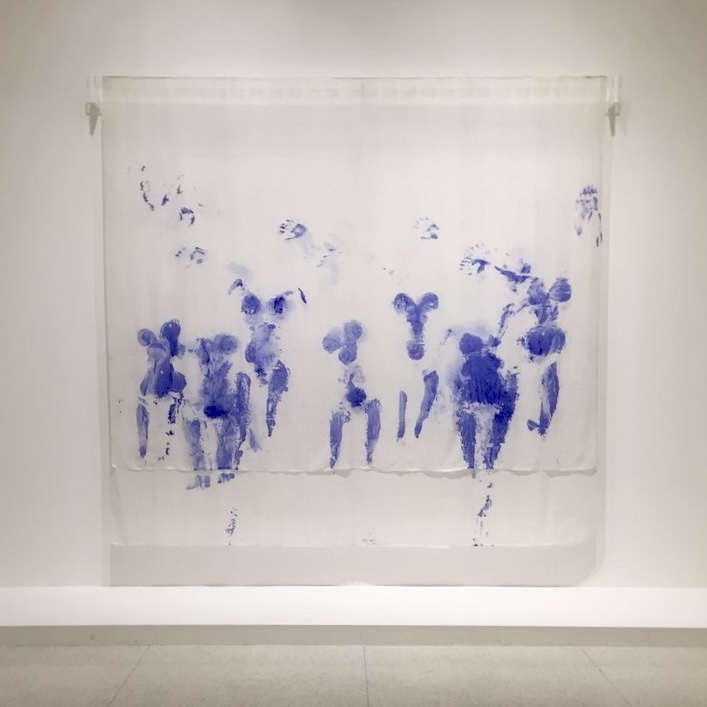
One of my earliest formative encounters with contemporary art was at the Walker Art Center in 2016, where I encountered the ultramarine work of Yves Klein. At the time, I did not possess enough knowledge of modern or contemporary art to understand the larger significance of what I was seeing. I had little sense of Klein’s position within postwar European art, nor of the conceptual questions that informed his use of color, material, absence, and immateriality. I simply encountered the work. Its significance for me emerged much later.
Nearly a decade on, visiting galleries has become one of the most consistent practices of my life. I enter them not only to see art, but because they continually expose me to ways of thinking that I would not otherwise encounter. A successful exhibition can introduce an unfamiliar artistic language, reorganize my understanding and appreciation of a material, or reveal connections between artists and ideas that previously seemed unrelated. Sometimes this effect is immediate. More often, it is cumulative. An exhibition seen years earlier can return unexpectedly through a piece of writing, a visual reference, a creative project, or another artist’s work. Looking produces a form of knowledge whose usefulness is rarely economically apparent at the moment of acquisition.
This is what I found absent from much of the recent discussion surrounding the economic viability of galleries. In “The End of the Mega Gallery,” Adam Lindemann responds to concerns about the sustainability of the gallery system by distinguishing between the economic position of mega-galleries and that of smaller and mid-sized businesses.
His argument is persuasive in several respects. Large galleries possess substantial brand equity, internationally recognizable rosters, extensive collector networks, and the financial capacity to function increasingly like global luxury businesses. Smaller galleries operate under considerably greater pressure, absorbing the costs of rent, shipping, art fairs, travel, staffing, production, and representation without any guarantee of recurring revenue.
To borrow a classic proverb, “money makes the world go round.” These are real constraints. A gallery cannot pay its employees or transport an artwork through cultural importance alone, nor should weak management, unsustainable expansion, or an incoherent program be excused on the grounds that art occupies a privileged position outside ordinary economic reasoning. Yet its less familiar counterpoint, “…however happiness greases the axle”, introduces a more fundamental question: the distinction between financial value and the broader forms of cultural and social value a gallery may produce. Evaluating a cultural institution exclusively through the relationship between financial risk and revenue obscures the full extent of the value it creates and distributes.
Lindemann himself gestures towards this distinction. Discussing Michael Heizer’s exhibition at Gagosian, he asks whether such a project made economic sense and then effectively dismisses the question, “Who cares. I loved it and went several times.” He describes projects that do not make economic sense as often among the best things galleries do. This observation deserves to be taken further. If some of the most important functions of a gallery occur precisely in activities that are difficult to defend through conventional profit calculations, then profitability alone is an incomplete measure of the institution.
In economic terms, galleries produce significant positive externalities. They bear the direct costs of exhibitions, spaces, research, staffing, transportation, communication, and artist development, while a considerable share of the benefits generated by those activities accrue elsewhere. Visitors acquire knowledge, artists encounter one another’s practices and ideas, designers absorb visual references, writers discover new subjects, filmmakers, architects, photographers, stylists, musicians, and creative directors encounter formal or conceptual ideas that subsequently migrate into other disciplines. An exhibition may influence a piece of work produced several years later by an individual who never bought anything from the gallery and whose subsequent economic activity will never appear on that gallery’s accounts.
The distinction is important because much of culture operates through precisely this form of indirect transmission. Ideas move between fields before they become legible as economic value. By the time a visual language appears in a campaign, retail environment, film, publication, or product, it may have passed through numerous earlier contexts and been transformed by them. The institution that helped make the original encounter possible rarely captures the eventual financial return.
My own professional development is, in a modest sense, an example of this process. Much of my work now depends upon the ability to identify references, establish relationships between ideas, distinguish between what is merely in vogue from what possesses greater conceptual depth, and translate cultural material across different contexts. These capacities are commercially useful, but they were not acquired solely through academic or professional experience. They were developed through repeated acts of looking.
Taste is trained through specificity and sustained attention. At present, depth depends increasingly on where we choose to direct that attention. A small, two-table coffee bar in Paris devoted almost entirely to coffee interests me for this reason: its narrowness creates the conditions for discernment, allowing subtle differences to become perceptible. Galleries operate according to a similar principle, creating temporary structures of concentrated attention through which distinctions can emerge.
Taste, in this sense, is a cultivated capacity for discernment. One acquires it through comparison, repetition, exposure, revision, and sophisticated disagreement. The question of what constitutes taste and, more contentiously, what distinguishes “good taste” from preference, convention, or cultural capital deserves a separate examination of its own, and is one I intend to return to in a future article.
The more art one sees, the greater the number of distinctions one becomes capable of making over time. Certain works that initially appear similar gradually separate, references become legible, and historical relationships emerge. One becomes better able to distinguish an idea from its aesthetic surface, or substance from novelty. Perhaps more importantly, one becomes increasingly comfortable malleating one’s mind.
Galleries participate in this education without necessarily calling themselves educational institutions. Their pedagogy is informal and often incomplete. A visitor may enter with little contextual knowledge, encounter work without understanding it, and leave without resolution. This is not necessarily a failure, as intellectual development does not always proceed through immediate comprehension. Sometimes the value of an encounter lies in giving a person a reference for which they will only later acquire the necessary context. A hero's journey, per se.
My encounter with Klein in 2016 now seems significant for precisely this reason. Its importance was retrospective. The work entered my visual vocabulary before I had sufficient knowledge to interpret it. Only through subsequent encounters with art did the earlier experience acquire greater meaning. Cultural knowledge often develops in this nonlinear way: first through exposure, later through recognition.
This is also why I think galleries perform a meaningful democratizing function, although the term requires qualification. The art world itself is not particularly democratic. Access to ownership is profoundly unequal; social and professional networks matter; certain galleries remain intimidating even to informed visitors; and large portions of the market operate through relationships that are effectively invisible to the general public. It would therefore be naïve to describe galleries as egalitarian institutions. What they can democratize, however, is proximity.
The gap between access to ownership and access to encounter is considerable. A visitor does not need to purchase a work in order to be affected by it. One can enter many commercial galleries without paying admission, spend time with objects worth far more than one could ever afford, read the accompanying material, form an opinion, and leave. The economic exclusivity of the object does not entirely determine the intellectual returns of the encounter.
For a newcomer to the creative world, this matters. Cultural literacy requires entry points. People cannot develop knowledge of fields to which they have never been exposed. Nor can future artists, collectors, curators, critics, designers, or other cultural producers emerge without first encountering work that gives them reason to become interested. The long-term value generated by such exposure is impossible to predict at an individual level, but that uncertainty does not make it nonexistent.
There is also an important social dimension to the gallery as an institution. Galleries create channels of communication between artists, audiences, curators, collectors, and practitioners working in adjacent fields. They allow work to circulate beyond the immediate environments in which it was made and, through acts of juxtaposition and curation, make relationships between practices visible that might otherwise remain dispersed.
I was reminded of this recently at Flowers Gallery on Cork Street, London, where Abstract Pairings placed two works by each of six British artists side by side, creating a dialogue both between different artists and between different moments within their respective practices. Michael Kidner’s pairing, for example, traced a trajectory from the colour-field concerns of Homage to Rothko (1956) to his later use of geometry and chaos theory in Lilypond (1999), allowing abstraction to be understood not as a fixed formal language but as one continually reworked in response to changing intellectual, social, and historical conditions.
A different form of dialogue was evident at Raven Row in London in Nomenclature for the Time Being, curated by Imani Mason Jordan, which brought together artists working across sculpture, performance, writing, photography, and video around shared material and sociopolitical concerns. Rather than proposing a simple thematic correspondence between otherwise separate works, the exhibition positioned these practices as part of what its curatorial framework describes as a “polyvocal and ongoing conversation”, particularly around Black feminist materiality, embodiment, diaspora, and the capacity of objects to act socially and politically.
In both cases, the gallery functioned not simply as a site in which individual works were displayed, but as a structure through which relationships between ideas, generations, materials, and artistic practices could be produced and made legible.
This relational function has economic significance precisely because its outcomes cannot be predetermined. Cultural innovation rarely follows the logic of established demand; it often depends upon institutions being willing to create conditions for comparison, experimentation, and intellectual exchange before the value of those encounters can be demonstrated. The gallery therefore assumes a form of risk that extends beyond the commercial risk of exhibiting a particular artist. It invests in the possibility that bringing distinct practices, histories, and ideas into proximity will produce forms of knowledge and cultural development whose consequences may only become visible later. An economic system concerned exclusively with immediate return is poorly equipped to account for this process, because the value generated through such encounters is frequently diffuse, cumulative, and realised beyond the exhibition itself.
An analogous dynamic can be observed outside the cultural sector in the redevelopment of the Commodore Hotel beside Grand Central Terminal in the late 1970s. The hotel had closed amid New York’s fiscal crisis and the deterioration of the surrounding area when Donald Trump, working with Hyatt and with substantial assistance from the city and New York State, undertook its redevelopment into the Grand Hyatt. The project itself was commercially risky, but its significance extended beyond the profitability of the hotel. Contemporary accounts described the completed Grand Hyatt as a centrepiece of the area’s resurgence and, notably, recorded that other investors had been waiting to see whether the Commodore redevelopment would succeed before committing capital of their own.
It would be reductive to attribute the revival of the Grand Central district to a single developer or project, as the wider economic recovery, public subsidies, and simultaneous investment elsewhere in the area were also consequential, but the episode demonstrates how the effects of an initial investment can extend considerably beyond the asset in which the risk was first taken. Its significance therefore lay not only in the asset itself, but in its capacity to alter the conditions for subsequent investment and urban activity.
None of this resolves the difficult economics facing galleries. Positive externalities do not pay rent, and public value does not automatically create a viable private business. Lindemann is correct to emphasize the extent to which small and mid-sized galleries confront structural pressures that differ markedly from those of global mega-galleries. Nor does cultural value provide an argument for preserving every gallery indefinitely; institutions close, programs lose relevance, business models require adjustment, artists change representation, and galleries must make decisions according to financial necessity. As Lindemann observes, galleries often cannot support artists indefinitely when sales disappear because they remain businesses with significant overhead.
The point, therefore, is not that economic analysis should be abandoned, but that a serious economic analysis must account for more than private financial return. This has been an unresolved tension in my own thinking since before I completed my BSc in Economics in 2023. Economics offers powerful tools for clarifying trade-offs and allocating scarce resources, yet its conclusions are necessarily shaped by what can be measured, monetised, and incorporated into the model. The difficulty becomes especially apparent when economic reasoning is applied to forms of value that do not translate easily into prices.
Timothy Noah illustrates this problem through the history of rear underride guards on American semi-trailers. After Jayne Mansfield was killed in a 1967 collision in which her car slid beneath a tractor-trailer, federal regulators proposed strengthening the guards intended to prevent such accidents. The regulation nevertheless took more than twenty-eight years to implement, during which successive administrations subjected it to cost-benefit analysis: in 1971 a human life was assigned no monetary value, in 1974 it was valued at approximately $200,000, and by 1996 at around $3 million, a valuation finally high enough for the regulation to satisfy the calculation. Nearly 9,000 people had died in similar accidents during the intervening period.
The example is not an argument against economics (a discipline I studied after all) so much as an illustration of its unresolved limits: a cost-benefit analysis can appear rigorous while remaining profoundly dependent on the assumptions governing what counts as value in the first place. The same problem, although obviously at a very different order of consequence, arises when assessing cultural institutions.
Catherine D’Ignazio and Lauren Klein articulate a related problem in Data Feminism through the proposition that “what gets counted counts”: what is captured by systems of measurement and classification becomes visible and actionable, while what is not counted risks becoming effectively invisible.
Their broader argument is that data and classification systems are not neutral representations of reality but structures shaped by decisions about what to observe, how to categorise it, and which forms of knowledge are made legible. If the benefits generated by galleries are excluded because they resist straightforward monetisation, or because they fall outside the categories through which conventional analysis makes value visible, their absence from the calculation should not be mistaken for an absence of economic or social value.
With that being said, contemporary economic analysis is far from perfect and this kind of evaluation would be difficult. A rigorous cost-benefit framework would have to consider and appropriately value the cultural capital produced by repeated public exposure to art, the professional development of artists, the educational value supplied to audiences, the networks created among cultural producers, and the eventual movement of ideas from galleries into other economically productive sectors. It would also have to account for option value: the value of preserving opportunities whose future significance cannot yet be known. An emerging artist, an experimental exhibition, or a visitor encountering contemporary art for the first time may produce no measurable return today while nevertheless generating substantial value later. Apologies to my analysts.
Such an analysis would require assumptions and imperfect proxies. Yet difficulty of measurement should not be confused with absence of value. Economic analysis regularly confronts effects whose monetary value cannot be directly observed. The purpose of such analysis is not to pretend that every dimension of human experience can be perfectly reduced to a price (one of my Roman empires), but to prevent unpriced benefits from disappearing entirely from decisions about priced costs.
The debate over galleries therefore reflects a larger problem in how cultural value is understood. We are very good at measuring transactions because transactions leave records. We are considerably worse at measuring the gradual formation of judgment, curiosity, knowledge, and imagination.
In this respect, the increasing incorporation of behavioral economics into mainstream economic and policy analysis is instructive. By challenging models that treat individuals as consistently rational and largely independent economic actors, behavioral economics has expanded the discipline’s recognition of the psychological, social, and contextual forces that shape human judgment and decision-making. Its growing integration into standard analytical practice suggests that the boundaries of economics are not fixed. When prevailing assumptions prove insufficient, the discipline is capable of sophisticating the framework through which human behaviour is understood.
This does not resolve the problem of assigning value to cultural formation, nor should behavioural economics be expected to do so; rather, it demonstrates the importance of continually examining which variables and forms of evidence an economic framework considers relevant. The processes through which cultural knowledge and judgment develop often unfold over years and across institutions, while their effects appear diffusely in other industries, other practices, and other people’s work.
Alberto Giacometti described artistic practice as a process through which continued work made the world increasingly unfamiliar to him: “The more I work, the more I see things differently, that is everything gains grandeur every day, and becomes more and more unknown, and more and more beautiful”. I return frequently to this idea because it describes not only the practice of making art but also the practice of looking at it.
Repeated exposure does not necessarily make the world more easily understood. Often it compounds in the opposite direction; it multiplies distinctions, reveals complexity where one previously saw simplicity, and makes familiar objects strange and unfamiliar objects intelligible. In doing so, it changes the observer over time in a chaotically random trajectory.
Nearly ten years after my first encounter with Klein, this is the value of galleries that I understand most clearly. The individual exhibitions have accumulated into a way of seeing. That way of seeing now informs my creative work, my professional judgment, my interests, the references through which I interpret the world, and the ways in which my work contributes to the cultural and creative contexts around me. The gallery that initially provided an encounter could never have captured that eventual value, nor could that value have been predicted at the time.
From the narrow perspective of a gallery's accounts, I was simply a visitor who entered without purchasing anything. From a longer perspective, the transaction was considerably more consequential.
An examination of the value galleries produce beyond their balance sheets, from cultural literacy and the formation of taste to artistic exchange, experimentation, and long-term economic spillovers. Drawing on personal experience, economics, contemporary exhibitions, and debates around measurement and behavioral analysis, the essay asks a broader question: what forms of value disappear when we only count what can be immediately priced?
One of my earliest formative encounters with contemporary art was at the Walker Art Center in 2016, where I encountered the ultramarine work of Yves Klein. At the time, I did not possess enough knowledge of modern or contemporary art to understand the larger significance of what I was seeing. I had little sense of Klein’s position within postwar European art, nor of the conceptual questions that informed his use of color, material, absence, and immateriality. I simply encountered the work. Its significance for me emerged much later.
Nearly a decade on, visiting galleries has become one of the most consistent practices of my life. I enter them not only to see art, but because they continually expose me to ways of thinking that I would not otherwise encounter. A successful exhibition can introduce an unfamiliar artistic language, reorganize my understanding and appreciation of a material, or reveal connections between artists and ideas that previously seemed unrelated. Sometimes this effect is immediate. More often, it is cumulative. An exhibition seen years earlier can return unexpectedly through a piece of writing, a visual reference, a creative project, or another artist’s work. Looking produces a form of knowledge whose usefulness is rarely economically apparent at the moment of acquisition.
This is what I found absent from much of the recent discussion surrounding the economic viability of galleries. In “The End of the Mega Gallery,” Adam Lindemann responds to concerns about the sustainability of the gallery system by distinguishing between the economic position of mega-galleries and that of smaller and mid-sized businesses.
His argument is persuasive in several respects. Large galleries possess substantial brand equity, internationally recognizable rosters, extensive collector networks, and the financial capacity to function increasingly like global luxury businesses. Smaller galleries operate under considerably greater pressure, absorbing the costs of rent, shipping, art fairs, travel, staffing, production, and representation without any guarantee of recurring revenue.
To borrow a classic proverb, “money makes the world go round.” These are real constraints. A gallery cannot pay its employees or transport an artwork through cultural importance alone, nor should weak management, unsustainable expansion, or an incoherent program be excused on the grounds that art occupies a privileged position outside ordinary economic reasoning. Yet its less familiar counterpoint, “…however happiness greases the axle”, introduces a more fundamental question: the distinction between financial value and the broader forms of cultural and social value a gallery may produce. Evaluating a cultural institution exclusively through the relationship between financial risk and revenue obscures the full extent of the value it creates and distributes.
Lindemann himself gestures towards this distinction. Discussing Michael Heizer’s exhibition at Gagosian, he asks whether such a project made economic sense and then effectively dismisses the question, “Who cares. I loved it and went several times.” He describes projects that do not make economic sense as often among the best things galleries do. This observation deserves to be taken further. If some of the most important functions of a gallery occur precisely in activities that are difficult to defend through conventional profit calculations, then profitability alone is an incomplete measure of the institution.
In economic terms, galleries produce significant positive externalities. They bear the direct costs of exhibitions, spaces, research, staffing, transportation, communication, and artist development, while a considerable share of the benefits generated by those activities accrue elsewhere. Visitors acquire knowledge, artists encounter one another’s practices and ideas, designers absorb visual references, writers discover new subjects, filmmakers, architects, photographers, stylists, musicians, and creative directors encounter formal or conceptual ideas that subsequently migrate into other disciplines. An exhibition may influence a piece of work produced several years later by an individual who never bought anything from the gallery and whose subsequent economic activity will never appear on that gallery’s accounts.
The distinction is important because much of culture operates through precisely this form of indirect transmission. Ideas move between fields before they become legible as economic value. By the time a visual language appears in a campaign, retail environment, film, publication, or product, it may have passed through numerous earlier contexts and been transformed by them. The institution that helped make the original encounter possible rarely captures the eventual financial return.
My own professional development is, in a modest sense, an example of this process. Much of my work now depends upon the ability to identify references, establish relationships between ideas, distinguish between what is merely in vogue from what possesses greater conceptual depth, and translate cultural material across different contexts. These capacities are commercially useful, but they were not acquired solely through academic or professional experience. They were developed through repeated acts of looking.
Taste is trained through specificity and sustained attention. At present, depth depends increasingly on where we choose to direct that attention. A small, two-table coffee bar in Paris devoted almost entirely to coffee interests me for this reason: its narrowness creates the conditions for discernment, allowing subtle differences to become perceptible. Galleries operate according to a similar principle, creating temporary structures of concentrated attention through which distinctions can emerge.
Taste, in this sense, is a cultivated capacity for discernment. One acquires it through comparison, repetition, exposure, revision, and sophisticated disagreement. The question of what constitutes taste and, more contentiously, what distinguishes “good taste” from preference, convention, or cultural capital deserves a separate examination of its own, and is one I intend to return to in a future article.
The more art one sees, the greater the number of distinctions one becomes capable of making over time. Certain works that initially appear similar gradually separate, references become legible, and historical relationships emerge. One becomes better able to distinguish an idea from its aesthetic surface, or substance from novelty. Perhaps more importantly, one becomes increasingly comfortable malleating one’s mind.
Galleries participate in this education without necessarily calling themselves educational institutions. Their pedagogy is informal and often incomplete. A visitor may enter with little contextual knowledge, encounter work without understanding it, and leave without resolution. This is not necessarily a failure, as intellectual development does not always proceed through immediate comprehension. Sometimes the value of an encounter lies in giving a person a reference for which they will only later acquire the necessary context. A hero's journey, per se.
My encounter with Klein in 2016 now seems significant for precisely this reason. Its importance was retrospective. The work entered my visual vocabulary before I had sufficient knowledge to interpret it. Only through subsequent encounters with art did the earlier experience acquire greater meaning. Cultural knowledge often develops in this nonlinear way: first through exposure, later through recognition.
This is also why I think galleries perform a meaningful democratizing function, although the term requires qualification. The art world itself is not particularly democratic. Access to ownership is profoundly unequal; social and professional networks matter; certain galleries remain intimidating even to informed visitors; and large portions of the market operate through relationships that are effectively invisible to the general public. It would therefore be naïve to describe galleries as egalitarian institutions. What they can democratize, however, is proximity.
The gap between access to ownership and access to encounter is considerable. A visitor does not need to purchase a work in order to be affected by it. One can enter many commercial galleries without paying admission, spend time with objects worth far more than one could ever afford, read the accompanying material, form an opinion, and leave. The economic exclusivity of the object does not entirely determine the intellectual returns of the encounter.
For a newcomer to the creative world, this matters. Cultural literacy requires entry points. People cannot develop knowledge of fields to which they have never been exposed. Nor can future artists, collectors, curators, critics, designers, or other cultural producers emerge without first encountering work that gives them reason to become interested. The long-term value generated by such exposure is impossible to predict at an individual level, but that uncertainty does not make it nonexistent.
There is also an important social dimension to the gallery as an institution. Galleries create channels of communication between artists, audiences, curators, collectors, and practitioners working in adjacent fields. They allow work to circulate beyond the immediate environments in which it was made and, through acts of juxtaposition and curation, make relationships between practices visible that might otherwise remain dispersed.
I was reminded of this recently at Flowers Gallery on Cork Street, London, where Abstract Pairings placed two works by each of six British artists side by side, creating a dialogue both between different artists and between different moments within their respective practices. Michael Kidner’s pairing, for example, traced a trajectory from the colour-field concerns of Homage to Rothko (1956) to his later use of geometry and chaos theory in Lilypond (1999), allowing abstraction to be understood not as a fixed formal language but as one continually reworked in response to changing intellectual, social, and historical conditions.
A different form of dialogue was evident at Raven Row in London in Nomenclature for the Time Being, curated by Imani Mason Jordan, which brought together artists working across sculpture, performance, writing, photography, and video around shared material and sociopolitical concerns. Rather than proposing a simple thematic correspondence between otherwise separate works, the exhibition positioned these practices as part of what its curatorial framework describes as a “polyvocal and ongoing conversation”, particularly around Black feminist materiality, embodiment, diaspora, and the capacity of objects to act socially and politically.
In both cases, the gallery functioned not simply as a site in which individual works were displayed, but as a structure through which relationships between ideas, generations, materials, and artistic practices could be produced and made legible.
This relational function has economic significance precisely because its outcomes cannot be predetermined. Cultural innovation rarely follows the logic of established demand; it often depends upon institutions being willing to create conditions for comparison, experimentation, and intellectual exchange before the value of those encounters can be demonstrated. The gallery therefore assumes a form of risk that extends beyond the commercial risk of exhibiting a particular artist. It invests in the possibility that bringing distinct practices, histories, and ideas into proximity will produce forms of knowledge and cultural development whose consequences may only become visible later. An economic system concerned exclusively with immediate return is poorly equipped to account for this process, because the value generated through such encounters is frequently diffuse, cumulative, and realised beyond the exhibition itself.
An analogous dynamic can be observed outside the cultural sector in the redevelopment of the Commodore Hotel beside Grand Central Terminal in the late 1970s. The hotel had closed amid New York’s fiscal crisis and the deterioration of the surrounding area when Donald Trump, working with Hyatt and with substantial assistance from the city and New York State, undertook its redevelopment into the Grand Hyatt. The project itself was commercially risky, but its significance extended beyond the profitability of the hotel. Contemporary accounts described the completed Grand Hyatt as a centrepiece of the area’s resurgence and, notably, recorded that other investors had been waiting to see whether the Commodore redevelopment would succeed before committing capital of their own.
It would be reductive to attribute the revival of the Grand Central district to a single developer or project, as the wider economic recovery, public subsidies, and simultaneous investment elsewhere in the area were also consequential, but the episode demonstrates how the effects of an initial investment can extend considerably beyond the asset in which the risk was first taken. Its significance therefore lay not only in the asset itself, but in its capacity to alter the conditions for subsequent investment and urban activity.
None of this resolves the difficult economics facing galleries. Positive externalities do not pay rent, and public value does not automatically create a viable private business. Lindemann is correct to emphasize the extent to which small and mid-sized galleries confront structural pressures that differ markedly from those of global mega-galleries. Nor does cultural value provide an argument for preserving every gallery indefinitely; institutions close, programs lose relevance, business models require adjustment, artists change representation, and galleries must make decisions according to financial necessity. As Lindemann observes, galleries often cannot support artists indefinitely when sales disappear because they remain businesses with significant overhead.
The point, therefore, is not that economic analysis should be abandoned, but that a serious economic analysis must account for more than private financial return. This has been an unresolved tension in my own thinking since before I completed my BSc in Economics in 2023. Economics offers powerful tools for clarifying trade-offs and allocating scarce resources, yet its conclusions are necessarily shaped by what can be measured, monetised, and incorporated into the model. The difficulty becomes especially apparent when economic reasoning is applied to forms of value that do not translate easily into prices.
Timothy Noah illustrates this problem through the history of rear underride guards on American semi-trailers. After Jayne Mansfield was killed in a 1967 collision in which her car slid beneath a tractor-trailer, federal regulators proposed strengthening the guards intended to prevent such accidents. The regulation nevertheless took more than twenty-eight years to implement, during which successive administrations subjected it to cost-benefit analysis: in 1971 a human life was assigned no monetary value, in 1974 it was valued at approximately $200,000, and by 1996 at around $3 million, a valuation finally high enough for the regulation to satisfy the calculation. Nearly 9,000 people had died in similar accidents during the intervening period.
The example is not an argument against economics (a discipline I studied after all) so much as an illustration of its unresolved limits: a cost-benefit analysis can appear rigorous while remaining profoundly dependent on the assumptions governing what counts as value in the first place. The same problem, although obviously at a very different order of consequence, arises when assessing cultural institutions.
Catherine D’Ignazio and Lauren Klein articulate a related problem in Data Feminism through the proposition that “what gets counted counts”: what is captured by systems of measurement and classification becomes visible and actionable, while what is not counted risks becoming effectively invisible.
Their broader argument is that data and classification systems are not neutral representations of reality but structures shaped by decisions about what to observe, how to categorise it, and which forms of knowledge are made legible. If the benefits generated by galleries are excluded because they resist straightforward monetisation, or because they fall outside the categories through which conventional analysis makes value visible, their absence from the calculation should not be mistaken for an absence of economic or social value.
With that being said, contemporary economic analysis is far from perfect and this kind of evaluation would be difficult. A rigorous cost-benefit framework would have to consider and appropriately value the cultural capital produced by repeated public exposure to art, the professional development of artists, the educational value supplied to audiences, the networks created among cultural producers, and the eventual movement of ideas from galleries into other economically productive sectors. It would also have to account for option value: the value of preserving opportunities whose future significance cannot yet be known. An emerging artist, an experimental exhibition, or a visitor encountering contemporary art for the first time may produce no measurable return today while nevertheless generating substantial value later. Apologies to my analysts.
Such an analysis would require assumptions and imperfect proxies. Yet difficulty of measurement should not be confused with absence of value. Economic analysis regularly confronts effects whose monetary value cannot be directly observed. The purpose of such analysis is not to pretend that every dimension of human experience can be perfectly reduced to a price (one of my Roman empires), but to prevent unpriced benefits from disappearing entirely from decisions about priced costs.
The debate over galleries therefore reflects a larger problem in how cultural value is understood. We are very good at measuring transactions because transactions leave records. We are considerably worse at measuring the gradual formation of judgment, curiosity, knowledge, and imagination.
In this respect, the increasing incorporation of behavioral economics into mainstream economic and policy analysis is instructive. By challenging models that treat individuals as consistently rational and largely independent economic actors, behavioral economics has expanded the discipline’s recognition of the psychological, social, and contextual forces that shape human judgment and decision-making. Its growing integration into standard analytical practice suggests that the boundaries of economics are not fixed. When prevailing assumptions prove insufficient, the discipline is capable of sophisticating the framework through which human behaviour is understood.
This does not resolve the problem of assigning value to cultural formation, nor should behavioural economics be expected to do so; rather, it demonstrates the importance of continually examining which variables and forms of evidence an economic framework considers relevant. The processes through which cultural knowledge and judgment develop often unfold over years and across institutions, while their effects appear diffusely in other industries, other practices, and other people’s work.
Alberto Giacometti described artistic practice as a process through which continued work made the world increasingly unfamiliar to him: “The more I work, the more I see things differently, that is everything gains grandeur every day, and becomes more and more unknown, and more and more beautiful”. I return frequently to this idea because it describes not only the practice of making art but also the practice of looking at it.
Repeated exposure does not necessarily make the world more easily understood. Often it compounds in the opposite direction; it multiplies distinctions, reveals complexity where one previously saw simplicity, and makes familiar objects strange and unfamiliar objects intelligible. In doing so, it changes the observer over time in a chaotically random trajectory.
Nearly ten years after my first encounter with Klein, this is the value of galleries that I understand most clearly. The individual exhibitions have accumulated into a way of seeing. That way of seeing now informs my creative work, my professional judgment, my interests, the references through which I interpret the world, and the ways in which my work contributes to the cultural and creative contexts around me. The gallery that initially provided an encounter could never have captured that eventual value, nor could that value have been predicted at the time.
From the narrow perspective of a gallery's accounts, I was simply a visitor who entered without purchasing anything. From a longer perspective, the transaction was considerably more consequential.